
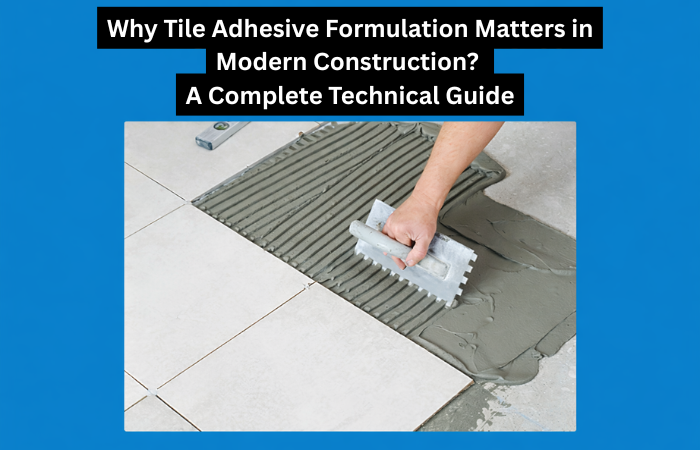
Tile installation has evolved far beyond the traditional cement–sand slurry method. Today’s construction industry demands precision, durability, flexibility, and long-term performance. Whether it is a residential bathroom, a commercial shopping mall, or a high-rise façade, tile adhesive performance directly determines the life of the installation.
Cracked tiles, hollow sounds, debonding, and surface failures are often blamed on installers. In reality, most failures originate from poor formulation design. This is why understanding the correct chemistry, material selection, and formulation ratios for C1 and C2 tile adhesives is critical.
A high-quality tile adhesive is not simply a mixture of cement and sand. It is a carefully engineered system of cement, graded fillers, polymers, and chemical additives, each playing a specific role in performance.
This guide explains:
-
The difference between C1 and C2 tile adhesives
-
The function of every raw material
-
Best-practice formulations for ceramic, porcelain, and large-format tiles
-
The correct balance of cement, sand, silica, HPMC, RDP, and PCE
Understanding Tile Adhesive Standards (C1 and C2 Explained)
Tile adhesives are classified according to EN 12004, the international standard for cementitious tile adhesives.
Difference Between C1 and C2 Tile Adhesives
| Classification | Adhesion Strength | Typical Application |
|---|---|---|
| C1 | ≥ 0.5 MPa | Ceramic tiles, interior walls, and floors |
| C2 | ≥ 1.0 MPa | Porcelain tiles, large-format tiles, façades, exterior areas |
Practical Meaning
-
C1 Tile Adhesive
Standard cementitious adhesive for porous ceramic tiles in low-stress environments. -
C2 Tile Adhesive
High-performance adhesive for dense, non-absorbent tiles and demanding conditions.
Using the wrong grade can result in early debonding, tile slippage, and costly rework.
Core Raw Materials Used in Tile Adhesive and Tile Bond
Cement – The Structural Backbone
Ordinary Portland Cement (OPC 42.5 or 53 grade) provides the main binding strength. Higher cement content increases adhesion but also raises cost and shrinkage risk, so balance is essential.
Graded Sand – Strength and Dimensional Stability
Washed and graded sand (0.1–0.6 mm) ensures:
-
Mechanical strength
-
Controlled shrinkage
-
Stable thickness
-
Consistent workability
Poor sand quality is one of the biggest reasons for inconsistent performance.
Silica / Quartz Powder – Packing Density & Surface Finish
Silica improves:
-
Particle packing density
-
Smoothness of application
-
Abrasion resistance
-
Adhesion consistency
It also reduces voids inside the adhesive layer, improving long-term durability.
Chemical Additives in Tile Adhesive Formulation
HPMC – Workability & Water Retention Controller
Hydroxypropyl Methylcellulose controls:
-
Water retention
-
Open time
-
Sag resistance
-
Trowelability
Without HPMC, cement hydrates too fast, causing poor bonding and weak adhesion.
RDP – Flexibility & Adhesion Booster
Redispersible Polymer Powder provides:
-
High adhesion strength
-
Flexibility
-
Impact resistance
-
Crack-bridging ability
RDP is mandatory for C2 adhesives and critical for porcelain and large tiles.
PCE – Dispersion & Strength Optimizer
Polycarboxylate Ether (PCE) is the modern superplasticizer that:
-
Reduces water demand
-
Improves cement dispersion
-
Enhances early and final strength
-
Improves workability without increasing cement
PCE allows manufacturers to achieve higher performance at optimized cost.
Why PCE Is Critical in Modern Tile Adhesive
PCE ensures uniform dispersion of cement particles, allowing maximum hydration with minimal water. This creates:
-
Higher density
-
Stronger bond strength
-
Lower porosity
-
Better durability
For porcelain and large-format tiles, where failure is not acceptable, PCE is no longer an option; it is essential.
Best Tile Adhesive Formula for C1 Grade (Ceramic Tiles)
Typical C1 Tile Adhesive Formulation
| Material | Percentage (%) |
|---|---|
| Cement | 30 – 35 |
| Graded Sand | 60 – 65 |
| Silica Powder | 3 – 5 |
| HPMC | 0.25 – 0.35 |
| RDP | 1.0 – 1.5 |
| PCE | 0.10 – 0.15 |
Performance Characteristics
-
Designed for ceramic tiles
-
Good workability and open time
-
Standard adhesion strength
-
Cost-effective for mass projects
Best Tile Adhesive Formula for C2 Grade (Porcelain & Large Tiles)
Typical C2 Tile Adhesive Formulation
| Material | Percentage (%) |
|---|---|
| Cement | 35 – 40 |
| Graded Sand | 50 – 55 |
| Silica Powder | 5 – 8 |
| HPMC | 0.30 – 0.40 |
| RDP | 2.0 – 3.5 |
| PCE | 0.15 – 0.25 |
Enhanced Properties
-
High adhesion strength
-
Excellent flexibility
-
Extended open time
-
Superior performance on dense tiles
-
Improved impact resistance
Separate Formulations for Different Tile Types
Tile Adhesive for Ceramic Tiles
-
Porous and lightweight
-
Moderate adhesion requirement
-
C1 formulation sufficient
Tile Adhesive for Porcelain Tiles
-
Dense and non-absorbent
-
Requires high bonding strength
-
C2 formulation mandatory
Tile Adhesive for Large-Format / Heavy Tiles
Requires:
-
Higher cement content
-
Higher RDP dosage
-
Controlled PCE for anti-slip
-
Strong sag resistance
Role of Each Ingredient in System Performance
| Ingredient | Function |
|---|---|
| Cement | Structural strength |
| Sand | Dimensional stability |
| Silica | Packing density |
| HPMC | Workability & water retention |
| RDP | Flexibility & adhesion |
| PCE | Dispersion & strength optimization |
A tile adhesive is a balanced chemical system. Overdosing or removing any component disrupts performance.
Optimum PCE Dosage & Interaction with Other Additives
Typical dosage: 0.10% – 0.25% of dry mix
Overdosing may cause:
-
Reduced open time
-
Segregation
-
Reduced sag resistance
-
HPMC incompatibility
A correct balance between HPMC, RDP, and PCE is critical.
Common Formulation Mistakes
-
Overusing PCE to reduce cement
-
Using poorly graded sand
-
Ignoring compatibility testing
-
Copy-paste formulas without trials
Every formulation must be validated through laboratory testing.
Manufacturing Best Practices
-
Use consistent raw material sources
-
Control sand moisture
-
Ensure uniform additive blending
-
Perform regular performance tests
In tile adhesive manufacturing, consistency equals profitability.
Quality Control & Performance Testing
According to EN 12004:
-
Adhesion strength
-
Open time
-
Slip resistance
-
Tensile bond after water immersion
These tests guarantee long-term performance.
Conclusion
A successful tile adhesive formulation is not about adding more cement; it is about using the right chemistry in the right proportions. When cement, sand, silica, HPMC, RDP, and PCE are properly balanced, the result is a reliable C1 or C2 adhesive system that delivers strong adhesion, flexibility, durability, and long-term performance.
With the right formulation strategy and dependable raw material partners like Tianjin Unilion International in Pakistan, manufacturers can confidently produce world-class tile adhesive solutions for ceramic, porcelain, and large-format tile applications.
Frequently Asked Questions (FAQs)
1. Can C1 adhesive be used for porcelain tiles?
No. Porcelain tiles require C2-grade adhesive due to low water absorption.
2. What is the ideal PCE dosage in tile adhesive?
Typically between 0.10% and 0.25% depending on formulation.
3. Is RDP mandatory for C2 adhesives?
Yes. RDP provides flexibility and high bonding strength.
4. Can one formula be used for all tile types?
No. Each tile type requires a tailored formulation.
5. Why does tile adhesive fail even with good materials?
Poor formulation balance and lack of testing are the main reasons.